Trump Tariffs: Economic Impact and Strategic Considerations for Traders
Trump’s tariffs reshape trade, fuel volatility, and challenge global market stability.
Trump Tariffs: Economic Impact and Strategic Considerations for Traders
President Trump’s far-reaching tariffs represent the United States’ most dramatic steps in trade policy in over 30 years. As traders assess how to position for what are likely to be long-lasting implications, fathoming the logic behind such action, forecasting the near and far-reaching outcomes of the tariffs and prepping a game plan to trade around them is critical. This article profiles the Trump tariffs, the reasoning underpinning them, the economic projections from major organizations, and their impact on international markets.
Profile of the Trump Tariffs
At the beginning of 2025, U.S. President Donald Trump proclaimed a series of tariffs aimed at reducing trade deficits and shoring up domestic industries. This included a blanket 10% duty on all imports to the U.S. starting March 4, 2025. Beyond that, the U.S. committed to implement countervailing tariffs of between 11% and 50% on places like China, the EU, Mexico, and Canada. That includes a duty of 54% on $460 billion of China’s imports, a 20% levy on EU products and a 25% import tax on goods shipped from Mexico and Canada.
On top of these broad measures, tariffs were specifically imposed on a number of industries. Notably, the initial 10% tariff on steel and the 10% tariff on aluminum were hiked to 25%, and a 25% duty was set to be put on car imports from March 3. Parts of autos were set to come in for similar treatment by April 3. As a result of these measures, the average U.S. tariff has surged to over 24%, hitting its highest level since 1910.
Objectives Behind the Measures
The current administration of Donald Trump lists several goals that should be achieved using tariffs. The most important objective of these tariffs is to cut the gigantic U.S. trade deficit, which exceeded one trillion U.S. dollars in 2024. They are also intended to protect the U.S. domestic car industry. U.S. were hoping that U.S. tariffs on imported vehicles and automotive parts would make them more competitive against the foreign rivals.
Furthermore, U.S. administration also looked for a huge rise in revenues from customs duties. According to public white and black numbers, the U.S. expected to 258 billion U.S. dollars per year through a higher preferential trade, which would correspond with 0.85% of the gross national product.
On top, the U.S. fight with the distribution of strong synthetic painkillers, which are responsible for a major part of the drugs addicted American people, and American military is involved in the trade dispute. One reason why Trump wants a trade war is that Mexico and Colombia have not done anything against the distribution of fentanyl; but the main reason is that Trump believes that the biggest foreign trade surplus is the main reason for the economic downturn of the United States.
Despite the frequently cited objectives, complainants express various concerns, mainly regarding increased prices for consumers, a threatened supply chain and reduced global competitiveness for U.S. businesses. Those and other eyewitnessnews had several other worries in mind when they learned that the Trump administration would like to enable the legislature of compelling a whole country to accept laws and rules.
The Impact on the Economy
Short-Term Prognosis
Leading financial institutions anticipate immediate economic consequences. J.P. Morgan projects a recession by late 2025 due to slowed GDP growth, expected to decline by 0.9%, and a rise in unemployment to 5.3%. Inflationary pressures are cited as a core risk. Similarly, Goldman Sachs increased its recession probability from 35% to 45%, citing falling consumer confidence and growing policy uncertainty.
Long-Term Projections
The longer-term effects could be even more consequential. Sustained tariff implementation may permanently reduce U.S. GDP by up to 2%, particularly if retaliatory measures follow from trading partners. Consumer prices are expected to rise by 2.3% in 2025 alone, translating to roughly $3,800 in additional annual costs for an average household. Job losses may reach up to 500,000 by year-end, largely driven by increased production expenses and reduced private investment. On the global stage, the volume of international trade is likely to decline by about 1%, while key partners such as China and the EU are already preparing countermeasures.
Market Reactions: Immediate Volatility and Gradual Realignment
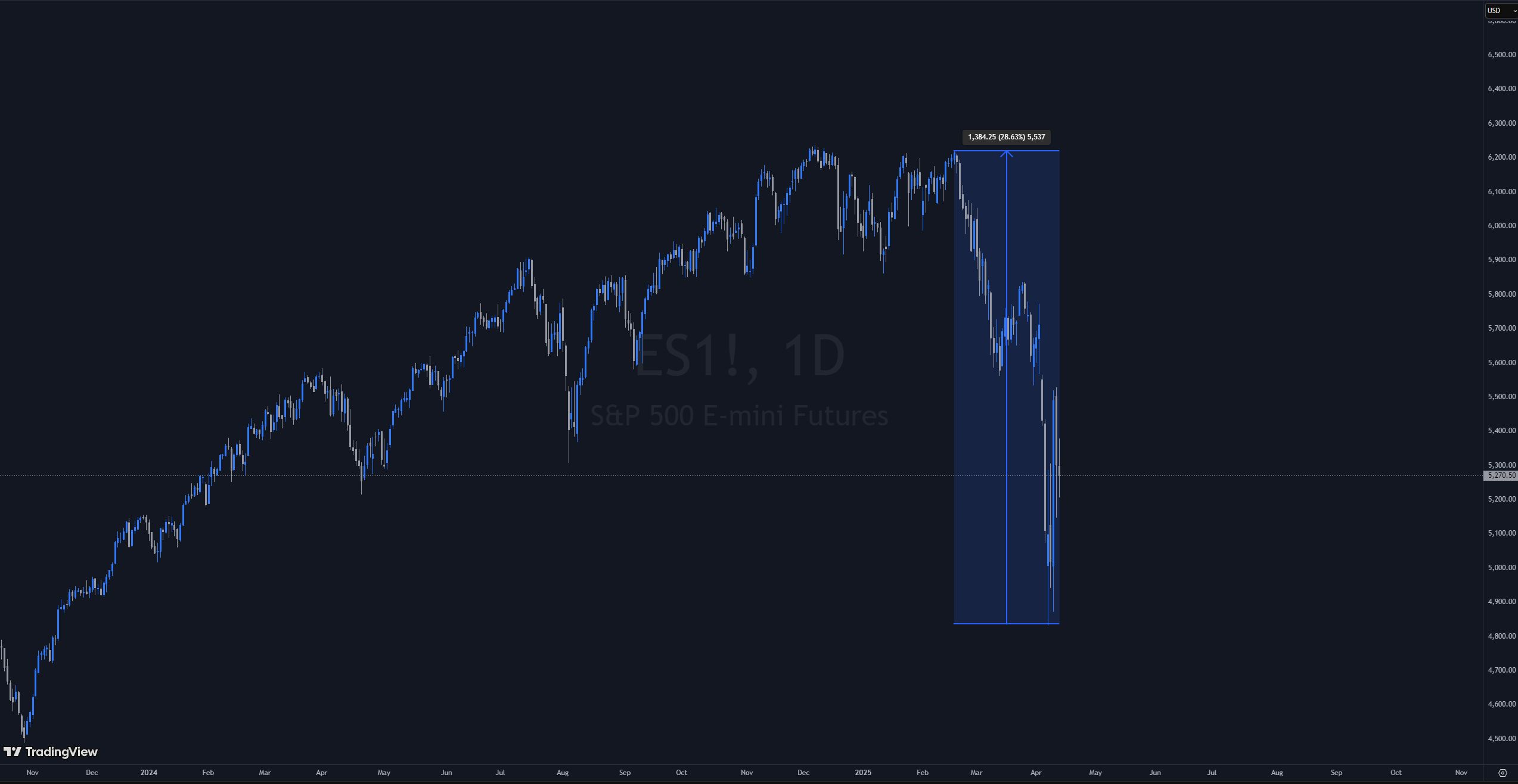
The financial markets have responded swiftly. The S&P 500 suffered a drop of nearly 4.8%, its steepest since the COVID-19 pandemic, while the Dow Jones fell almost 4%. Safe-haven assets surged, with gold reaching record highs, climbing 12%, and the U.S. dollar weakening by 5% against the yen.
Certain sectors are particularly exposed. The automotive industry has seen notable impacts, with Tesla's stock declining by 18% and Volkswagen’s by 15% due to increased input costs. In the technology sector, Apple anticipates product price increases of over $2,000 per unit because of Chinese tariffs. Retail giants like Nike and Target have also been hit, with double-digit declines tied to their dependency on Asian manufacturing.
As a response, some companies are proactively shifting their operations. Samsung and Toyota are planning new facilities in Mexico to bypass tariffs. Meanwhile, many European firms are expanding their presence in Southeast Asia to diversify supply chains and reduce exposure to U.S. policy shifts.
Strategic Approaches for Traders
To navigate this complex environment, traders must adopt flexible, informed strategies.
Hedging against recession risks remains a priority. Allocating capital to safe-haven assets such as gold can offer protection. Short positions on economically sensitive indices like the Dow Jones Transport or the CAC 40 may also provide opportunities.
Traders can also seek to benefit from sector disparities. Defense companies, like Lockheed Martin, have gained from anticipated increases in government spending. Similarly, energy companies such as ExxonMobil are positioned to profit from growing domestic demand, driven in part by constrained global supply.
Finally, close monitoring of trade negotiations is essential. Exemptions granted under frameworks like USMCA may create sector-specific relief or stability. Commodity stock levels—for materials like copper and oil—can serve as valuable early indicators of broader economic shifts.
Conclusion
The Trump tariffs represent a historic and aggressive redirection of U.S. trade policy, with major implications for domestic and international markets. While the stated goals focus on reducing deficits and boosting U.S. industry, the likely outcomes include higher consumer prices, declining GDP growth, and increased volatility across financial markets.
For traders, especially those operating within prop firms, agility and informed decision-making are critical. Staying on top of macroeconomic indicators, diversifying exposure, and leveraging volatility with derivatives are all strategies that will become increasingly important. Risk management remains central to success.
Given the evolving political context and the nature of current U.S. leadership, the information in this article is subject to rapid change. Traders are encouraged to verify developments regularly, as policy shifts under the Trump administration may impact the relevance of this analysis in the near future.
Subscribe to our weekly newsletter
Stay informed, master the markets, and achieve your goals.